Warning: This essay will contain spoilers for The Witcher 3: Wild Hunt and some references to The Witcher novels.
Having already discussed the Third Nilfgaard War in the first section, this part of the essay will discuss some of the major players as well as a lesser political situation which Geralt can become involved in.
Part I available to read herePart III available to read here.
Emhyr var Emreis, Deithwen Addan yn Carn aep Morvudd (a.k.a "The White Flame Dancing On the Grave of His Enemies")
"Because we broke their spine at Sodden. We broke them militarily, and above all we broke their morale. I don’t know whether it is true that Emhyr var Emreis was, at the time, against aggression on such a scale, that the attack on Cintra was the work of some party hostile to him – I take it that if they had defeated us, he would be applauding, and distributing privileges and endowments amongst them. But after Sodden it suddenly turns out he was against it, and that everything which occurred was due to his marshals’ insubordination. And heads fell. The scaffolds flowed with blood. These are certain facts, not rumors. Eight solemn executions, and many more modest ones. Several apparently natural yet mysterious deaths, a good many cases of people suddenly choosing to retire. I tell you, Emhyr fell into a rage and practically finished off his own commanders."
-King Henselt, Blood of Elves
No more character in the whole of The Witcher franchise is more controversial than Emhyr var Emreis. He is one of the earliest characters introduced in the franchise, appearing during "A Question of Price" before returning in "The Blood of Elves" as a figure who is the not-so-secret mastermind behind Nilfgaard's aggression.
Under Emhyr's control, the Nilfgaard have invaded the lands of the North three times, created the terrorist Scoia'tael, assassinated Kings, and been involved in numerous plots both great and small. He is also responsible for a lengthy attempt to hunt down his daughter Ciri in order to force her to marry him so that he could create a Chosen One who would rule half then world then a grandchild who would rule the entirety of it. Thankfully, he turned his back on his action at the last minute despite nothing preventing him from doing so but his conscience.
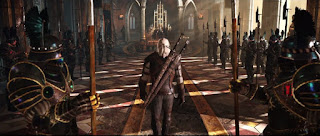 |
| Geralt's meeting with Emhyr is a meeting of book and game history. He is meeting his archenemy, friend, and rival in the throne room of friend who's kingdom Emhyr has conquered. |
However, the question of King Emhyr in The Witcher 3: Wild Hunt is not his political military or political legacy but his relationship to the monster-hunter Geralt of Rivia as well as his daughter Ciri of Cintra. When we meet Emhyr it is after being requested to do so by Geralt's long-time lover and pseudo-spouse Yennefer of Vengerberg with the explicit assumption he wishes to help a returned Ciri. Specifically, he wishes to give Ciri rulership of the Empire by naming her his heir and abdicating.
The central choice in the game, even more so than Reasons of State, politically is whether Geralt of Rivia chooses to play the role of Kingmaker and deliver his daughter to Emhyrs. Much fan debate has been had over whether Geralt is paternalistic by refusing to take Ciri there, whether or not Ciri should be convinced to refuse him of her own accord, or other issues which we will cover in the Ciri section. What it does say, however, is that Emhyr has tired of his position as Emperor and is attempting to secure his legacy.
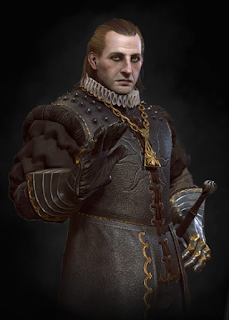 |
| The next Emperor of Nilfgaard? Ciri's husband? Tool? |
In the end, Geralt's relationship with Emhyr will determine the fate of the entire North as well as Nilfgaard based on how much the Witcher chooses to trusts the man's motives. If he believes in Emhyr and his sincerity, then Ciri is going to be his heir and Emhyr's political legacy his secured. If he chooses not to, Emhyr may or may not win the war against Redania but his dynasty remains in grave peril. If Geralt chooses to ignore Radovid's atrocities or support Dijkstra then the Emperor of Nilfgaard will, for better or worse, die friendless and alone at the hands of his own subjects.
Perhaps having just reconciled with his daughter.
Ciri of Cintra
Neutrality? Indifference? She wanted to scream. A witcher looking on indifferently? No! A witcher has to defend people. From the leshy, the vampire, the werewolf. And not only from them. He has to defend people from every evil. And in Transriver I saw what evil is. A witcher has to defend and save. To defend men so that they aren’t hung on trees by their hands, aren’t impaled and left to die. To defend fair girls from being spread-eagled between stakes rammed into the ground. Defend children so they aren’t slaughtered and thrown into a well. Even a cat burned alive in a torched barn deserves to be defended. That’s why I’m going to become a witcher, that’s why I’ve got a sword, to defend people like those in Sodden and Transriver – because they don’t have swords, don’t know the steps, half-turns, dodges and pirouettes. No one has taught them how to fight, they are defenceless and helpless in face of the werewolf and the Nilfgaardian marauder. They’re teaching me to fight so that I can defend the helpless. And that’s what I’m going to do. Never will I be neutral. Never will I be indifferent. Never!
-Ciri of Cintra, Blood of Elves.
Admitting to my complete and utter bias is my belief Ciri of Cintra is one of the greatest female characters of fantasy literature. She ranks up there with Daenerys Targaryen, Dana Scully, and Eowyn for people I think of as amongst my favorite characters in storytelling period. As such, I will make no attempt to hide my favoritism for her. I hope she's the main character of The Witcher 4 or her own successful series of spin-off games. Be that as it may, Ciri's role in the politics of Wild Hunt is less playing the role of one football team or another's player but the ball.
Ciri of Cintra represents the only hope for Emperor Emhyr's dynasty to continue since there is no sign his marriage to the False Ciri has born any heirs in the past seven years. Indeed, causal chatter with the young and sprightly General Voorhis indicates that there is already plans for him to be Emperor (though this may be due to the assumption he will marry Ciri the moment she ascends to the throne in order to secure the allegiance of Nilfgaard's nobility after Emhyr's two marriages to Cintrans).
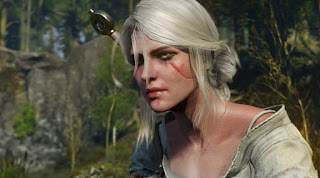 |
| To be wield two swords or wear a crown is her choice. In other fables, this wouldn't be a choice but the Witcher is far more ambiguous. |
Ciri's opinion on ruling Nilfgaard seem to be ambivalent, at best, and the game doesn't give any options to have Geralt discuss the issue with her before or after her optional meeting with Emhyr. Being the Lady of Time and Space, rulership of Nilfgaard is less impressive to her than it might be to other people since the largest empire in the Continent is a spec of sand in the universe's very large beach. She's also been offered the less-than-welcome attentions of beings like King Eredin, ruler of his own planet.
Part of this ambivalence may come to her past experiences with both Nilfgaard as well as Emperor Emhyr who, through accident or design, is responsible for the deaths of both her mother and grandmother. Ciri also expresses during her quest, "Payback", a desire for normal life where she is able to travel and live and love amongst the common folk. Nevertheless, should she choose to meet with Emhyr, he is able to persuade her to become Empress through arguments we are not privy to.
The only hints are in the "Empress" ending which indicate she believes she can do more good as a Empress than as a Witcher, which may be objectively true or false depending on a variety of elements ranging from political climate to successors if she chooses not to ascend the throne. There is still a somber mood to the ascension and one cannot help but assume even if it is by her own choice, Ciri does not want the crown or its responsibilities. Book readers will certainly know that Ciri's desires are as far away from responsibility and power as possible.
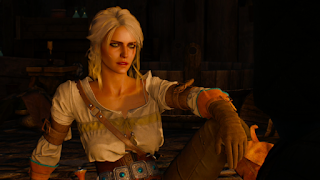 |
| Age has matured Ciri a great deal. |
Ciri would, in all likelihood, be an amazing Empress as one of the few royals for whom common people as well as nonhumans were not lesser beings. However, these very same attitudes would make her position as ruler difficult as well as isolate her from her peers (which an Empress wouldn't have anyway given the way Emhyr is treated by his subordinates). Perhaps it is for the best the Empress Ending, as such, ends on uncertainty since all politics in this game are built under a fog of war which never lets up until the ending slides.
Skellige
Compared to the rest of the game, the politics of Skellige are mercifully straightforward. The previous King of Skellige has died, leaving behind an adult son and widow (along with a second widow who commits ritual suicide to be with him in the afterlife). Due to Skellige traditions being clan-based semi-democratic, the next King will be chosen by mutual consent of the Jarls.
Queen Bran, who is sadly a woman who might as well scream "Villain" postulates that they need to do away with this semblance of democracy and instead adopt (presumably primogenitor) hereditary monarchy as a principle. This sounds ridiculous to modern ears but is actually not that insane due to the "hard to polish a turd" problem of monarchy.
Skellige is a primitive disunited island nation with numerous feuding clans and almost no ability to project force onto the larger world. A single dictator with a hereditary lineage offers a far greater opportunity for Skellige to be a modernized political-military force in the future. In any ending where she succeeds with her Frey-esque "Bloody Banquet" plan, her son will actually do just that.
Geralt of Rivis much more likely to side with his long-time family friends in the Craite lineage, however. The two choices for monarch there are Cerys an Craite and Hjalmar an Craite with both bringing something to the table. From a modern perspective, Cerys is the obvious candidate due to the fact she's a level-headed peace-maker and wise despite her age. She's a bit hot-blooded but that may be a saving grace in a land poisoned by such attitudes. Hjalmar, by contrast, is kind of an idiot who's epic adventure against a giant gets most of his crew killed and only deals with the surface elements of a plot.
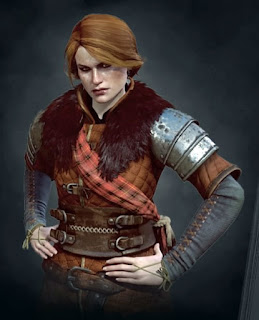 |
| The best woman for the job? Perhaps. Peace is a pearl without price but those who set down their weapons invite attack. |
Conclusion
One of the biggest things the Witcher emphasizes in its portrayal of politics is the inscrutability of motivations, trustworthiness of one's allies, as well as the unintended consequences of one's actions. Emhyr is absolutely sincere with his offer to make Ciri Empress of Nilfgaard but Geralt doesn't know this and is left with contradictory information over whether or not he can be trusted (we see Emhyr betray Letho while sparing cities, for example).
Likewise, Ciri's own motivations are malleable depending on Emhyr and Geralt's diplomacy. Given a fair chance, Emhyr will persuade her to support his dynasty by becoming his heir but Geralt can persuade her to forgo this path simply by saying Emhyr is manipulative. Human nature's role in politics has shattered kingdoms and changed government's courses forever and this is very often on display.
Skellige really brings this home as the clearly most-qualified candidate may not be the best woman in the job for the long run but that largely depends on factors entirely unknown to the people who elect her as well as events which Geralt can shift in multiple directions. Ceyrs is the worst sort of candidate for dealing with Emhyr or Radovid but Cerys is likely to be able to sell peace with Empress Ciri. Cerys or King Bran might be able to come to an agreement with Dijkstra while Hjalmar would simply spark a war.
NEXT - CHURCH AND STATE, LODGE OF SORCERESSES, AND ENDINGS